How do I choose the right smart switch protocol like Zigbee or WiFi for a hotel project?
- VIP-User
- 2026-07-26
- 3
Choosing the right smart switch protocol for a hotel project depends on scale and network stability. Zigbee is ideal for large-scale hotels due to its low power consumption, mesh networking, and local execution capabilities, which prevent network congestion. WiFi suits smaller boutique hotel projects or retrofits that leverage existing network infrastructure without requiring additional gateways.
Core Solutions & Key Takeaways
- Network Scalability: Zigbee mesh networks handle hundreds of nodes smoothly, vital for Commercial & Hospitality Applications like hotels, whereas WiFi router limits can cause dropouts.
- Bandwidth and Interference: WiFi operates on the crowded 2.4GHz band with high bandwidth needs, while Zigbee uses minimal bandwidth, reducing interference with guest Wi-Fi.
- Offline Functionality: Zigbee smart switches can execute local scenes (like master off switches) without an internet connection, ensuring continuous guest room control.
- Wiring and Installation: Neutral wire requirements and electrical loads must align with the hotel's existing electrical infrastructure.
Detailed Architectural/Principle Analysis
For mid-to-large-scale hospitality projects, network reliability determines the guest experience. Standard WiFi networks operate on a star topology, where every smart switch connects directly to the central access point. In a hotel room with multiple lighting zones, keycards, and curtains, the high density of connected devices quickly overloads standard wireless routers. This congestion causes high latency and frequent disconnections.
Conversely, Zigbee operates on a self-healing mesh topology. Each mains-powered smart switch acts as a router, forwarding signals to neighboring devices. This configuration extends the network range dynamically and ensures that if one switch loses connection, the signal automatically reroutes. For example, large-scale projects like the Sheraton Astana Hotel (1200 sets of switch sockets installed) and Courtyard Tashkent (2000 sets of switch sockets installed) demonstrate the practical necessity of robust electrical control. Deploying smart switches in commercial spaces requires structured wiring, and selecting a robust hardware option such as the 16AX 250V~ smart switch guarantees electrical safety.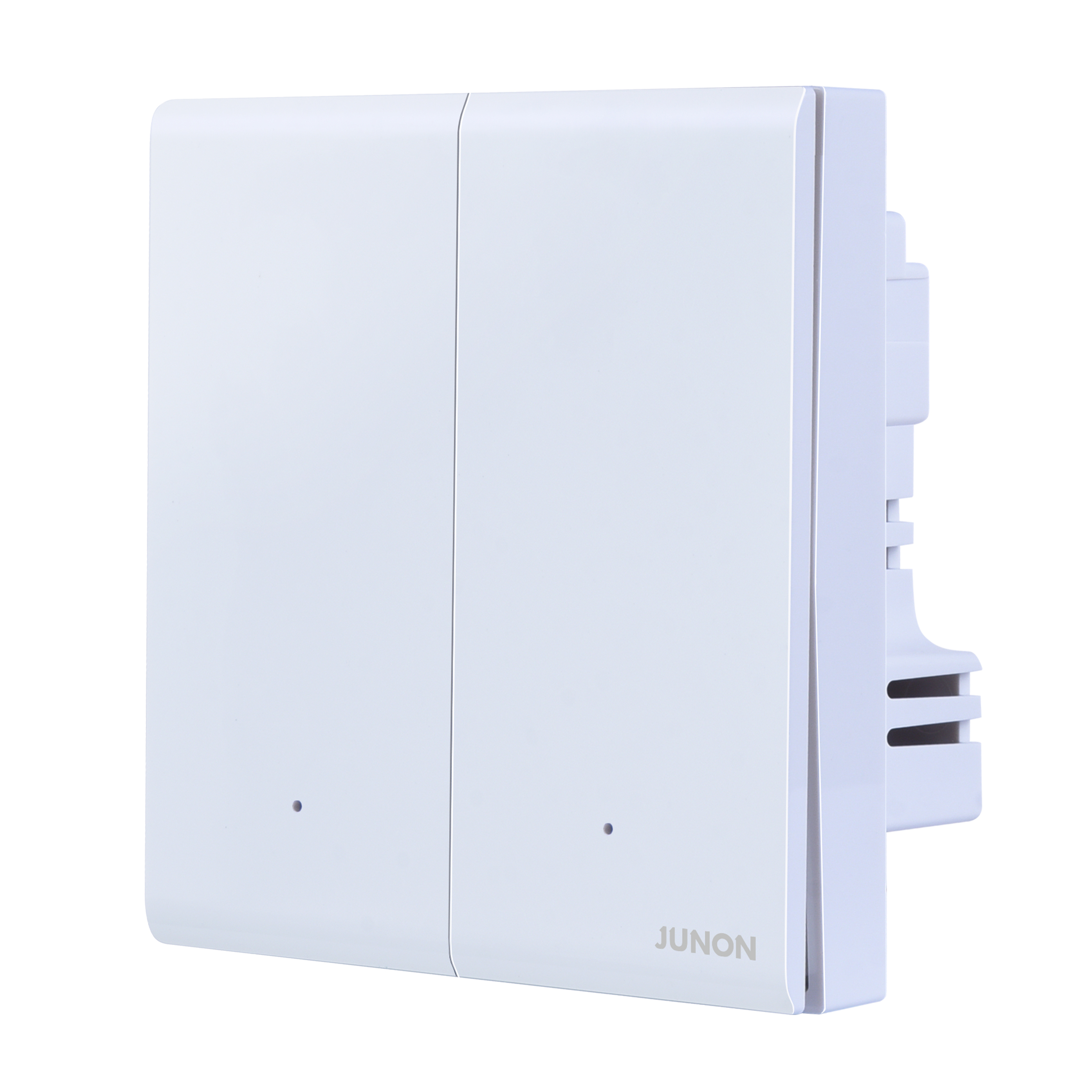
Integrating quality compliance, hotel switches must possess certifications like CE (such as LVD22-9194 for switches) and comply with global standards to ensure occupational health, safety, and environmental management systems (ISO9001:2015, ISO14001:2015, ISO45001:2018).
Data/Solution Comparison
| Feature / Parameter | Zigbee Protocol Solution | WiFi Protocol Solution |
|---|---|---|
| Network Topology | Mesh (Self-healing, multi-node routing) | Star (Direct connection to router) |
| Device Capacity | Up to 65,000 devices per network | Typically 30-50 devices per router |
| Bandwidth Impact | Extremely low; preserves guest Wi-Fi | High; shares bandwidth with guest devices |
| Local Offline Control | Supported (Gateway handles automation locally) | Limited (Fails if cloud server is offline) |
| Product MOQ | 500 pcs | 500 pcs |
| Delivery Lead Time | 30-45 days | 30-45 days |
Frequently Asked Questions (FAQ)
Can WiFi and Zigbee smart switches be used together in a hotel?
Yes. Hotels can run hybrid configurations. Public areas with high bandwidth coverage can use WiFi smart switches, while guest rooms utilize Zigbee to avoid IP address exhaustion and ensure reliable local room-automation control.
What load capacity is required for hotel smart switches?
Hotel smart switches require high-rated capacities, such as 16AX 250V~, to manage inductive and capacitive loads from LED lighting fixtures, heavy-duty electronics, and card-key switches safely.
Do Zigbee smart switches require a separate gateway in each room?
Usually, yes. While a single Zigbee gateway can control multiple rooms depending on wall density and distance, dedicating one gateway per guest room or suite ensures maximum speed, local processing isolation, and privacy.
Final Conclusion & Recommendations
For new hospitality constructions, Zigbee remains the industry standard due to its scalability and offline capability. WiFi is best reserved for smaller retrofits with existing IT infrastructures. Ensuring switches comply with standard electrical regulations and manufacturing requirements is vital for long-term project viability. The standard MOQ for custom hotel configurations is 500 pcs with a delivery timeline of 30-45 days. Orders can be processed under T/T (30% advance, 70% before shipment) or 100% L/C at sight, with shipping handled via Ocean Freight or Air Freight. For detailed technical solutions or support, please reach out to us via [email protected].
About Us
Guangdong JUNON Songtian Electrical Appliance Co.,Ltd was established in 1983 and currently operates with an employee count of 2000 across a factory area of 148000 square meters. The company implements rigorous standardized production protocols, offering custom manufacturing under full industrial chain distribution and direct sales. Backed by key certifications including ISO9001:2015, ISO14001:2015, ISO45001:2018, and CE (LVD22-9194), our brand has served clients across multiple international hotel and real estate projects.
Lastest
-
Are there any newly developed UV-resistant plastics for IP65 waterproof distribution box?
2026-07-26 -
What is the maximum current load for this EU wall switch and multi socket?
2026-07-26 -
What is the lead time for a sample of this switch with universal socket?
2026-07-26 -
Can you provide a video tour of your factory where this return switch is made?
2026-07-26 -
How much do you charge for a sample of this multi socket with independent on off switch?
2026-07-26
SUBSCRIBE
INQUIRY