What is the future outlook for IoT integration in MCB circuit breaker distribution box?
- VIP-User
- 2026-07-25
- 3
The future outlook for IoT integration in MCB circuit breaker distribution boxes centers on real-time remote telemetry, predictive thermal diagnostics, and automated load balancing. Implementing micro-sensors and wireless modules within flush-mounted enclosures allows operators to monitor branch circuits continuously, preventing electrical hazards and optimizing power distribution efficiency across facility networks.
Core Solutions & Key Takeaways
- Active Thermal Monitoring: IoT integration enables continuous temperature sensing near the busbars, preventing localized overheating before physical breaker failure.
- Granular Energy Analytics: Real-time current and voltage monitoring at the branch level allows facility operators to track consumption patterns and implement peak-shaving strategies.
- Targeted Application Deployments:
- Residential & Domestic Applications: Provides safe, real-time power leakage detection and remote isolation to enhance household safety.
- Commercial & Hospitality Applications: Delivers micro-level utility billing and energy tracking to minimize operational waste in complex facilities.
- Industrial & Logistic Applications: Supports heavy-duty power demands with continuous overload alerts, protecting high-capacity logistic systems.
- Physical Infrastructure Foundations: Upgrading to smart distribution systems requires premium mechanical housing, such as enclosures featuring 1.2mm thick iron sheets and pure copper busbars to withstand electrical stress.
Detailed Architectural/Principle Analysis
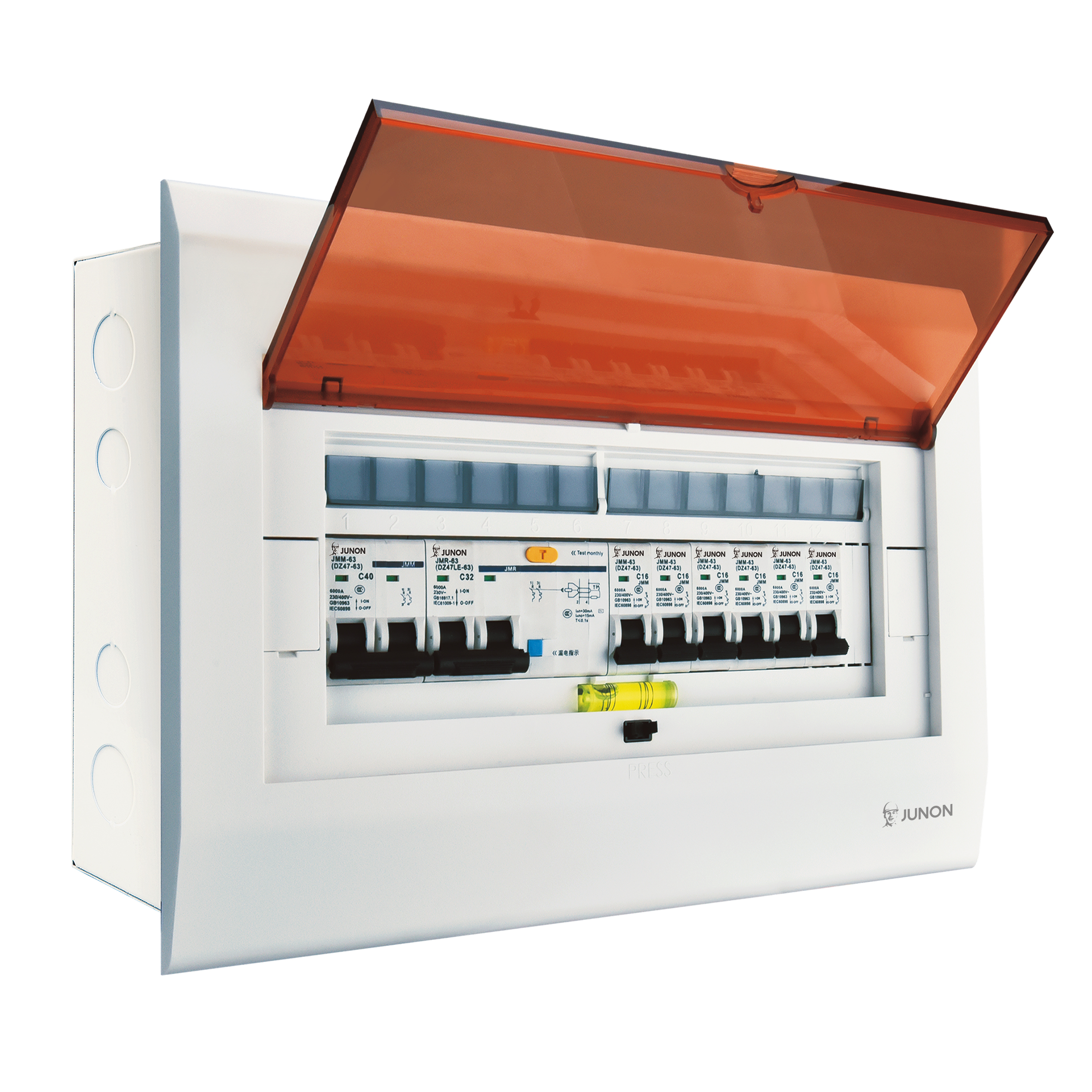
Transforming a standard MCB distribution box into an IoT-enabled node requires a physical architecture that balances signal transmission with electromagnetic shielding. Traditional enclosures often present RF signal attenuation due to solid metal wrappers. Advanced solutions, such as the V8+ series, resolve this conflict by utilizing a durable 1.2mm thick iron sheet base for structural rigidity and wall anchoring, coupled with a high-grade PC cover that allows wireless radio frequencies (such as Wi-Fi, Zigbee, or LoRa) to pass through without signal loss.
Inside the enclosure, thermal management becomes critical when microprocessors, communication modules, and current transformers are packed alongside standard MCBs. Using highly conductive components, specifically pure copper busbars and terminal bars, reduces the baseline electrical resistance inside the box. This minimization of internal heat generation is vital to prevent the premature aging of sensitive electronic sensor boards.
To ensure hardware reliability during smart component deployment, Guangdong JUNON Songtian Electrical Appliance Co.,Ltd utilizes high-precision automated production. Founded in 1983, the manufacturer leverages over 30 engineers and designers to match smart-grid physical specifications with industrial demands.
Environmental and quality compliance further guarantee long-term operational viability. Production lines operating under ISO9001:2015, ISO14001:2015, and ISO45001:2018 standards ensure that every enclosure meets tight mechanical tolerances. Standard safety certifications, including CE compliance for switches and CB certifications for sockets, confirm that the housing materials provide the necessary flame retardancy and dielectric strength required to protect both standard switchgear and sensitive IoT telemetry units.
Data/Solution Comparison
The table below highlights the physical and operational differences between standard distribution enclosures and those optimized for IoT integration.
| Feature Parameter | Standard Enclosure (e.g., V8+ Series) | IoT-Enabled Smart Enclosure |
|---|---|---|
| Base Construction | 1.2mm thick iron sheet metal base | 1.2mm thick iron sheet with sensor mounting tracks |
| Busbar & Terminal Blocks | Pure copper busbar and terminal bars | Pure copper with integrated shunt resistor spaces |
| Data Acquisition | None (Requires manual thermal imaging) | Continuous branch-circuit current, voltage, and temperature telemetry |
| Enclosure Cover | Flame-retardant PC cover | RF-transparent flame-retardant PC cover |
| Configuration Space | 13 way flush mounted layout | 13 way flush mounted layout with dedicated auxiliary gateway space |
| Safety Standards | CE, CB, and RoHS compliant | CE, CB, RoHS compliant with advanced EMC shielding |
Frequently Asked Questions (FAQ)
Can standard flush-mounted distribution boxes be upgraded for IoT integration?
Yes, provided the enclosure offers sufficient depth and heat dissipation. Enclosures utilizing a 1.2mm thick iron sheet and PC covers provide the structural integrity and RF signal transparency required for retrofitting smart sensors and wireless communication modules.
What standards apply to IoT-enabled MCB circuit breaker distribution boxes?
They must meet rigorous electrical and safety benchmarks. High-quality enclosures align with international production quality systems such as ISO9001:2015 and hold relevant safety credentials like CE and CB certifications to guarantee insulation and flame resistance.
How does a metal base compare to plastic bases in smart distribution enclosures?
A 1.2mm thick iron sheet metal base provides superior mechanical protection, structural stability, and electromagnetic shielding for integrated microprocessors, while a PC cover allows wireless signals to penetrate without signal attenuation.
Final Conclusion & Recommendations
The transition toward IoT-integrated MCB circuit breaker distribution boxes represents a significant step forward in building automation and electrical safety. Utilizing highly conductive pure copper busbars and flame-retardant PC covers ensures that physical enclosures can support the thermal and structural demands of smart sensors. Global contractors have validated this mechanical reliability in large-scale projects, including the Seda Vertis North in Quezon City (438 pcs distribution box) and the Garden Inn Nairobi Airport (200 sets distribution box), where sturdy enclosures were selected for dependable circuit protection. For projects upgrading to smart distribution systems, sourcing robust hardware under flexible business models (with a minimum order quantity of 500 pcs per model and ocean or air shipping methods) ensures a reliable foundation. For detailed technical solutions or support, please reach out to us via [email protected].
About Us
Guangdong JUNON Songtian Electrical Appliance Co.,Ltd is an established manufacturer of switches, sockets, distribution boxes, and LED lights. Founded in 1983, the company houses 2,000 employees and operates a 148,000 square meter factory. Leveraging over 30 engineers and designers, the enterprise ensures high-precision manufacturing using advanced testing and automated equipment, serving clients in over 52 countries. The facility operates under certified ISO9001:2015, ISO14001:2015, and ISO45001:2018 standards.

Lastest
-
Are there any newly developed UV-resistant plastics for IP65 waterproof distribution box?
2026-07-25 -
What is the maximum current load for this EU wall switch and multi socket?
2026-07-25 -
What is the lead time for a sample of this switch with universal socket?
2026-07-25 -
Can you provide a video tour of your factory where this return switch is made?
2026-07-25 -
How much do you charge for a sample of this multi socket with independent on off switch?
2026-07-25
SUBSCRIBE
INQUIRY